Arrow Infographic Five Step: A Visual Strategy for Modern Communication
In today’s fast-paced digital environment, clarity and visual impact are essential for conveying complex ideas. The Arrow Infographic Five Step has emerged as a powerful tool for professionals across industries, offering a structured yet dynamic way to illustrate processes, workflows, and strategic plans. Whether used in presentations, reports, or marketing materials, this infographic format combines modern design principles with intuitive navigation, making it a go-to solution for visual storytelling.
What Makes the Arrow Infographic Five Step Stand Out?
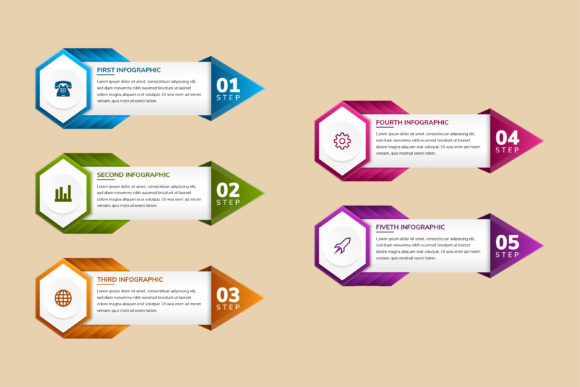
The Arrow Infographic Five Step is a visual framework that uses directional arrows to guide the viewer through a sequence of five distinct stages. Each step is often represented by a geometric shape—such as a hexagon or triangle—that contains an icon or brief description. This design not only enhances readability but also reinforces the logical flow of information. The use of vectors ensures scalability without loss of quality, making these infographics suitable for both print and digital platforms.
Unlike static layouts, the Arrow Infographic Five Step is inherently interactive in feel. The diagonal or curved arrows create a sense of movement, helping the audience follow the narrative effortlessly. This makes it especially useful for explaining processes in business, education, project management, and technology.
Aligning with Modern Design Trends
Visual communication has evolved significantly, with users expecting more from digital content than ever before. Today’s audiences prefer modern, clean, and mobile-friendly designs that convey information quickly and effectively. The Arrow Infographic Five Step fits perfectly into this trend by offering a visually engaging way to present data without overwhelming the viewer.
Designers and marketers are increasingly using colorful timeline infographic templates as part of their content strategy. These templates often feature a combination of arrows, icons, and geometric elements to create a cohesive visual narrative. The inclusion of hexagons or triangles adds a layer of sophistication and allows for modular customization, which is ideal for platforms like websites, social media, and digital reports.
Why the Five-Step Model Works
The five-step model is not just a design choice—it’s a cognitive one. Human brains process information more efficiently when it’s broken into manageable chunks. The Arrow Infographic Five Step leverages this principle by segmenting complex workflows into digestible parts. This approach is especially effective in marketing, where conveying a clear value proposition or customer journey is key to engagement.
For example, a SaaS company might use this infographic to illustrate its product onboarding process. Each step could represent a phase such as sign-up, setup, training, usage, and support. By using icons and color-coded arrows, the company can guide users through the journey visually, improving comprehension and retention.
Practical Applications Across Industries
The versatility of the Arrow Infographic Five Step makes it a valuable asset for a wide range of professionals:
- Businesses can use it to outline strategic plans, sales pipelines, or customer service workflows.
- Educators may find it useful for illustrating learning objectives or curriculum progression.
- Marketers can apply it to explain campaign funnels, content strategies, or conversion paths.
- Developers and designers often integrate these infographics into dashboards or user onboarding experiences to simplify complex processes.
Moreover, the availability of vector-based templates allows for easy customization. Designers can tweak colors, icons, and layout structures to match brand guidelines or specific project needs. This adaptability ensures that the Arrow Infographic Five Step remains relevant across different use cases and platforms.
Design Elements That Enhance Clarity
Several design elements contribute to the effectiveness of the Arrow Infographic Five Step:
- Arrows – Provide directional guidance and help maintain a logical flow.
- Hexagons and triangles – Add visual interest and can represent different types of steps or actions.
- Icons – Offer a quick visual cue, making the content more accessible and memorable.
- Color coding – Helps differentiate steps and highlight key information.
- Minimal text – Keeps the focus on visuals and prevents information overload.
When combined, these elements create a balanced layout that enhances both aesthetics and functionality. Designers often use diagonal or curved arrows to create a sense of movement, which can make the infographic feel more dynamic and engaging.
How to Use Arrow Infographics Effectively
While the Arrow Infographic Five Step is a powerful visual tool, its effectiveness depends on how it's implemented. Here are some best practices:
- Keep it simple – Avoid overcrowding the design with too much text or detail. Focus on the core message.
- Use consistent styling – Ensure all arrows, shapes, and icons follow a unified visual language.
- Test for clarity – Show the infographic to a few users to see if they can follow the flow without explanation.
- Optimize for different formats – Make sure the design works well on both web and print, especially if it’s part of a brochure, banner, or presentation.
- Align with your brand – Use brand colors and fonts to maintain consistency across all communications.
By following these guidelines, creators can ensure their Arrow Infographic Five Step is not only visually appealing but also functionally effective.
Future-Proofing Visual Communication
As digital communication continues to evolve, the demand for intuitive, visually driven content will only grow. Tools like the Arrow Infographic Five Step are well-positioned to meet this demand by offering a flexible, scalable, and user-friendly solution. With the rise of remote collaboration, online learning, and data-driven storytelling, the ability to convey complex ideas clearly and concisely has never been more important.
Looking ahead, we can expect to see more integration of these infographics into interactive platforms, such as dashboards and mobile apps. Designers may also experiment with animations and micro-interactions to enhance engagement. However, the core value of the Arrow Infographic Five Step—its ability to simplify complexity—will remain unchanged.